
Sunday, June 7, 2026

Home Blog Page 1762
Sineng

“India Has Already Overtaken The Us And Has Become The Second Largest Solar Power Market In The World”

0
  1. Mr. Harjinder Kamboj, Head-Quality Azure talks about future of India’s solar industry and quality parameter that should be maintained.
  2. Where do you see the Solar Energy industry in India poised for the next 10 years?  

Solar Energy Industry is expected to grow at a very fast pace in India owing to majorly four positive factors: 

  1. Robust demand due to good economic growth.
  2. Increasing investment because the sector has become quite attractive for both foreign and domestic investors.
  3. Policy support as Government has ramped-up target to achieve 100GW solar installation by 2022. Hopefully, this trend will continue beyond 2022 as well. 
  4. Competitiveness advantage that India has because of the availability of sunlight throughout the year.   

We have seen that in recent years, growth of solar energy in emerging markets had been phenomenal. India has already overtaken the US and has become the second largest solar power market in the world, in terms of solar power installations. 

The country currently stands at almost 25 GW of grid-connected solar power capacity as compared to 9 GW in 2015. Large scale solar installations in India account for 87 percent of solar capacity while rooftop sector has also picked-up. Last year, solar accounted for nearly 53 percent of new energy capacity additions in the country and this is great news for solar sector.

For a developing country like India, where electricity for every home was once considered a dream is now close to reality. The government initiative of ‘power for all’ is changing the socio-economic structure of the country. In fact, people are demand 24×7 power supply and Government is also working tirelessly to fulfil their demand.

The sector also has immense potential to create new jobs; 1 GW of Solar manufacturing facility generates approximately 4000 direct and indirect jobs. In addition, solar deployment, operations and maintenance creates additional recurring jobs in the sector.

Are we seeing a major push towards better & smarter technology in solar sector by the EPC contractors? 

With power tariff hitting all time low, developers are under tremendous pressure on cost. So, at present, more focus is on reduction of project cost per KWp, while maintaining quality of equipment and construction at the same level.  

However, a lot of developments have been seen in this regard, like; 

  • Development and use of new construction machinery and tools for a quick project handling. 
  • Optimization of efficiency and reliability of photovoltaic systems.
  • Use of String Inverters rather than Central Inverters in order to minimise the mis-match losses and to maximise the output.  
  • R&D of utility-scale energy storage systems for stabilization of regional power grids. 
  • Combination of Wind, Solar and even fuel-based energy sources in Hybrid Power Plants.
  • Co-operation with energy suppliers and grid operators for an utmost environmentally-friendly and inexhaustible source of energy. 
  • Remote installation monitoring by drone-based system.

Solar project should be designed for a life of 25 years. What quality parameters should mounting structures adhere to, in order to sustain over this period?  

Solar Mounting Structures are critical components in solar power plants, which support the solar panels on the ground or on rooftops. They ensure the structural stability of the solar system.

Solar panels need secure fastening to the roof or ground to protect against high velocity winds. Moreover, solar panels also require protection against water logging and other elements that gather on the ground or on the roof. Mounting structures must adhere to adverse environment conditions. 

The Mounting structure shall be so designed to withstand the speed for the wind zone of the location where a PV system is proposed to be installed. 

It may be ensured that the design has been certified by a recognized Lab / Institution and submit Wind Load calculation sheet to MEDA. 

Suitable fastening arrangement and grouting should be provided in order to secure the installation against the specific wind speed.

The mounting structure steel shall be as per latest IS 2062: 1992 and galvanization of the mounting structure shall be in compliance of latest IS 4759.

Structural material shall be corrosion resistant and electrolytically compatible with the materials used in the module frame, its fasteners, nuts and bolts.

Aluminium structures also can be used, particularly in rooftop installations which can withstand the wind speed of respective wind zone. 

Apart from design and selection of suitable steel grade, it is also necessary to protect the structure parts from rusting either by coating or anodization. 

Suppliers, having robust manufacturing and Coating facilities should be selected for supply of structures. 

Do We Need Stricter Product Certification Guidelines And Quality Standards For The Solar Sector?

Yes, off course. As I said earlier, there is tremendous pressure on the cost of the projects. So, wherever possible, component manufacturers would try to optimize the cost. 

Therefore, in order to ensure the desired Quality of the components, stricter Product Certifications and Quality Standards must be implemented on all critical equipment, like PV Modules, Transformer, Inverters, Cable, Panels, Module Mounting Structures etc. 

Inspection and Testing must be ensured at factory before these components are shipped to sites. 

As we know that PV module being most expensive and critical items in the PV Plant, so special focus must be given on selection and qualification of module suppliers through review of IEC / BIS certificates, factory audits, close monitoring of quality parameters during production and pre-shipment inspection according to relevant standards.  

In order to ensure reliability of PV Modules, sequential testing methods need to be incorporated.

List some of the challenges you come across while developing a project?  

Despite tremendous efforts from Government to promote Clean Energy in India, Solar industry has been facing a lot of barriers, like: 

Training and development of human resources to drive industry growth and PV adoption. 

The lack of closer industry-government cooperation for the technology to achieve scale.

Land allotment & PPA signing is a long procedure under the Generation Based Incentive scheme. 

Lack of better financing infrastructure, models and arrangements. 

Lack of collaborative, focused and goals driven R&D to help India attain technology leadership. 

Domestic manufacturing failed to take advantage of Safe-Guard import duty imposed on PV Solar Modules, even after one year of imposition.  Government should consider some other way-out in order to help the domestic Solar manufacturing sector. 

There is a need for more promotional incentives by Government and better industry-government co-operation in order to give a further push the Solar Industry in India.  
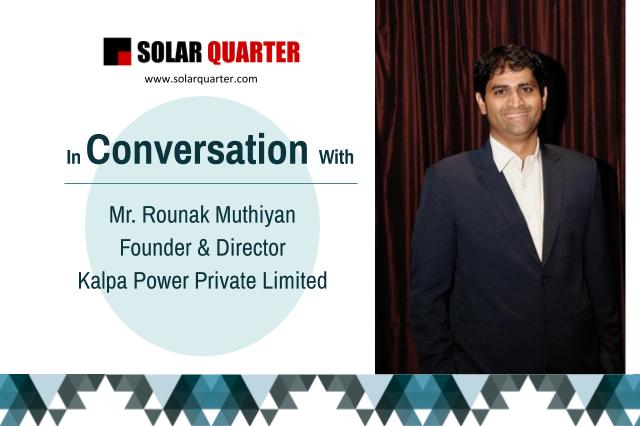
“Kalpa Power Is An End To End Solution Provider Of Solar Power Plant Projects”

0
Mr. Rounak Muthiyan, Founder & Director Kalpa Power Private Limited provides his perspective on solar rooftop sector in India and more…
  • Give us a glimpse about your company presence and offering in the solar sector?
  • Kalpa Power is an end to end solution provider of solar power plant projects. Kalpa prides itself in being able to develop solutions which are highly customised, user oriented and seek to maximize benefits through cost effective technology deployment with least operational overheads. Our team of experienced professionals make sure installations across India occur seamlessly at the same high standards ascribed by us to achieve maximum benefits from any given locations. We have achieved a capacity of 16 + MW in solar generation across India and have another 15 MW in India and 3 MW in West Asia in the pipeline.  We are in the business of solar power for the last 5 years and have the necessary experience and expertise in Design, Procurement of quality products and project execution, along with an excellent Finance and Administrative teams which manages the day to day operation and fund requirement of the company. This results in making timely project execution and commissioning. Apart from EPC team, we also have strong Operation and Maintenance team which ensures proper monitoring of installed solar power plant and aims for zero break down, by having real time monitoring system as every single unit generation from solar power plant count

Where do you see your Kalpa Power 10 years from now?

 Without subsidies, in 2016, globally solar became more competitive than the coal based or thermal power plants. Since then, the solar prices have come down substantially. In 2012, less than 10% of the annual capacity added in the world came from solar. Last year, it was over 25%. Hence there are huge growth opportunities. You have got a situation where the market is projected to grow fast and by 2022 , approximately 2% to 3% of the electricity will be generated by solar globally. The opportunity over the next 10 years is immense because this number will have to go up and become a substantial number for the world energy market.  As we are expanding our operation on a global level, alongwith current projects in pipeline we are optimistic we can make a remarkable achievement in the field of Renewable energy globally in the next 10 years. We have cumulative target of 50 MW in next 2-3 years.

Taking forward our knowledge and expertise in solar, we are venturing into solar powered Electric Vehicle supply equipment (EVSE). Traditional electricity sourced from conventional sources is expensive, and losses are high to convert electricity from AC to the required standards for EVSE for charging. Hence solar and EVSE are a natural fit. We’ve already received an EoI from large corporate and government entities in this regard. We have started development in this sector by designing and manufacturing of efficient smart chargers for electric vehicles which are expected to hit the market by the end of FY 2019 or by early FY 2020.  

What are the key drivers of growth in the solar rooftop segments?

Solar power provides a decentralized option to address growing power needs of a vast-expansive country like India. Kalpa power envisions to fulfill the needs of the country by providing cheap and affordable power. Solar power can be designed to size so as to meet the needs and requirements of the urban as well as the rural people of India by providing independence from foreign sources of energy, thus enabling stable energy prices for the future. Increasing the supply of renewable energy would allow us to replace carbon-intensive energy sources and significantly reduce India’s total CO2 emissions.

High energy cost and tariffs usually affects the operating margins of many manufacturers, industry and commercial complexes. Green and clean energy being a prime objective and step towards sustainable development, has been a major key drivers in the solar rooftop segments. This initiative is taken by many leading industries. Another key driver for growth is net metering policy, which encourages end consumer to take benefit of excess generation from solar power plant.

How has GST impacted solar rooftop industry in India?

GST has indeed made an impact on capital cost of solar project. According to a recent study published by the Council on Energy, Environment and Water(CEEW) and the International Institute for Sustainable Development (IISD), the introduction of GST has led to an increase in cost of generation of solar power by almost 6 per cent. The current GST structure discourages a potential client to go for solar . With the government aiming for ambitious target of 100 GW  and with current market scenario GST for solar need a relook from government. If you observe last three quarters, capacity addition of solar project have been declining. Cut down of GST on Solar rooftop should be major objective of MNRE, that will boost up solar capacity addition. It is important to continuously monitor and examine if fiscal measures are being effectively wielded, to support India’s larger national objectives with implications for sustainable development. The introduction of the safeguard duty on solar panels has compounded the uncertainty, resulting in delays in deployment of solar projects. Combined with the imposition of safeguard duty (making majority of the PV panels used expensive) and the cap on solar power tariffs, the GST impact may have a bearing on the profitability of companies in this sector.

“The “Hero Approach” Of Owning A Renewable Energy Project Is Based On Business Case Certainty Of 25 Years”

0
Mr. K.V.Sajay, President – Wind, Solar and Regulatory Affair Hero Future Energies shares his valuable insights on the significance of energy storage and untapped opportunities that can be explored.

What according to you is the biggest strength of Hero Future Energies in the solar sector?

Hero Future Energies (HFE) is the renewable energy arm of the Hero Group, which is an extremely diversified industrial conglomerate. The group’s flagship company is Hero Motocorp but we also have auto component company, finance company, electronic company, university and of course renewable energy.

We are one of India’s fastest growing renewable energy developer. The “Hero approach” of owning a renewable energy project is based on business case certainty of 25 years or more, this in turn helps to bid and build robust assets with the right HSEQ standards in a time bound manner.

How significant is energy storage for the development of solar sector?

One of the distinctive characteristics of the electric power sector is that the amount of electricity that can be generated is relatively fixed over short periods of time, although demand for electricity fluctuates throughout the day. Energy storage can assume a larger role in matching the demand and supply. At the same time, technological development, better utilization of transmission assets and rapid price reduction of other technologies like thermal storage and battery energy storage along with rapid penetration of intermittent renewable energy like solar and wind, have created a renewed demand for energy storage technologies.

Energy storage will also support buyers by supplying power during peak period along the day at competitive prices against the power from conventional sources during such period which is procured by paying premium charges.

What do you think are the untapped opportunities which needs to be explored in the solar sector?

Solar sector has evolved from being focused on heat transfer-based method of power generation to solar photovoltaic based power generation during the last decade under the JNNSM and it’s still evolving as we speak.

Thus, we see very high opportunities in the fields of domestic solar PV module manufacturing with integrated supply chain of polysilicon to PV modules instead of cells to PV modules to cater the demand of both domestic and international market (100+ GW per annum).

Technological development in battery-based energy storage system clubbed with solar/ wind energy generation has huge potential in the coming years. A shift to green alternative will be attractive as compared to conventional power based on pricing.

India has ~ 36 GW of installed wind capacity. Most of these farms also happen to be in high solar insolation zones and if proper hybridization is done even to the 50% (i.e., 18 GW) of such installed capacity along with solar and energy storage solutions, it will result in better utilization of existing transmission systems along with increase in capacity utilization factor and reduction in variability of power from renewable sources. Also, it means that about 18 GW capacity can be added in a short span of 1 year to the country’s overall renewable target.

A lot has been done to improve the policy and regulatory framework for the sector. What are the problems that persist with in the sector?

In FY18 capacity addition in renewables was 2.5 times the capacity addition in conventional energy generation during the same period. This sector has seen numerous off takers in the bids conducted by SECI, NTPC, MSEDCL, GUVNL and other nodal agencies during second half of 2018 and so far in the first half of 2019, thus we expect considerable capacity addition in the years ahead.

This wave of optimism coupled with strong regulatory framework is the need of the hour. However, challenges to be dealt includes outstanding overdues with DISCOMs, slower augmentation of transmission infrastructure, threatening and challenging the sanctity of long-term power purchase agreements by state government, uncertainty of waiver of transmission charges beyond March 2022 etc.

Additionally, to spur investment in this sector few more challenges namely mismatch in timelines of solar projects, deemed non-agricultural conversion of land for use in solar projects, curtailment of power from renewable sources and non-adherence to “Must Run” status for renewable projects need to be addressed.

It is worth mentioning that union government had already taken cognisance of situation and invited RE developers in recently conducted Chintan Baithak by MNRE to address the challenges faced by the sector. Let 2019 be the time when leaders in government and business of renewables can jointly drive sectoral growth, create employment and transit towards a carbon free economy.

What more can Indian government do to propel the growth of the sector?

To improve the bankability of projects, the government should focus on the following pointers, which might seem micro in nature but is of utmost importance to gain confidence of any investor or banker.

  • Development of single window clearance for all requisite approvals
  • Flexibility in terms of size and timing of equity infusion
  • Deemed generation compensation at 100% of applicable tariff in case of grid curtailment
  • Time bound adoption of tariff discovered under tariff based competitive bidding by ERCs without any re-examination of such discovered tariff
  • Timely payment to renewable generators
  • Extension of financial closure and commissioning timelines for actual/ genuine delays in government approvals
  • Pre-defined formula for calculating impact of new duty on cell and modules
  • Increase the duration of PPAs from existing 25 years to 35 years for solar, wind and storage-based hybrid projects


Mono Vs Poly – An Introspective Simulation Study! – Part 3

0

While the previous two parts of the article “Mono vs Poly – An introspective simulation study! – Part 1 & Part 2” introduced the types of crystalline technology, the need for this study, the methodology of study and detailed technical results of all climatic zones, this part would present a financial analysis of both the plants and educate its readers on the key takeaways from the study.

Figure 1: Division of climatic zones in India (Source: IIT Bombay)

Financial analysis

With the energy sources around the world constantly increasing, it is important for a source to be commercially viable and give back good returns to ensure its widespread uptake. In such situations, only proving a source’s technical superiority may just not be enough. An in-depth financial analysis and its gains need to be identified in detail. The initial cost break up of a solar power plant is well known and is well represented by various bodies. In such break up, the solar modules constitute more than 50% of the cost, whereas the BoS accounts for around 35% of the cost. The civil works and other costs constitute merely 13% of the cost. While the number stands true, the comparison between mono and poly crystalline technology paints a different picture.

The study presented two different scenarios; the financial analysis however is calculated on per MW basis to fairly evaluate the technology. Firstly, the fact that the initial cost of mono crystalline technology is more cannot be argued upon. This leads to a sharp increase in the module’s initial price i.e. ~21% higher than poly crystalline technology. However, now with the changing dynamics in the PV market of the world and with the world demanding higher energy from the same module size, the prices of mono crystalline PV modules are deemed to fall down drastically. It is an already known fact that mono crystalline module (of similar sizes) are usually at 1~2% higher efficient than the poly crystalline modules. This efficiency advantage leads to a direct 12% reduction in number of solar modules required per MW of power plant when utilizing mono crystalline technology. Further, considering a standard double racking design in a power plant, the cost savings in module mounting structure installed in a mono crystalline modules is 0.25% (when compared to a poly crystalline module based plant). Considering the land requirement, significant savings could be clearly realized in a mono crystalline based power plant. Considering central inverter in both the cases, we find that a mono based power plant could use 31% less land (and hence 31% less cost) compared to poly crystalline module based plant.

While designing a power plant, adequate care needs to be taken to ensure that the electrical losses are minimal and/or within the tolerance limits. One of the easiest yet important parameter to optimize is the DC voltage drop in cables. The drop depends primarily on the internal resistance of the cable which is further governed by the length and the cross sectional area of the cable. With an increase in number of modules to be utilized in a poly crystalline technology based power plant, the length of the cable increases which directly increases the internal resistance of the wire. In order to mitigate such losses, the cross sectional area of the cable needs to be increases. Both increase in length and area acts as a double whammy increasing the cabling cost of module by around 10.50% when compared to mono crystalline based power plant. Operation & maintenance (O&M) plays a significant role in any power plant if it is to run smoothly and perform as expected. Considering the case of a solar power plant, as a rule of thumb O&M cost is considered only to be around 1% annually of the plant’s total cost. However with the need to clean & maintain more modules, AJB’s and other DC spares in a poly crystalline based power plant its cost raises significantly. It was found that in a mono crystalline based power plant, a savings in O&M cost to the tune of 38% could be realized (refer Figure 2).

Figure 2: Difference in investments incurred per MW during the life time of the power plant

Figure 3: Savings realized while utilizing mono crystalline technology over the plant lifetime

With both the incurred cost and energy generated in the favour of mono crystalline technology, it should be clear by now that mono crystalline technology which looks expensive, is actually profitable in the longer run. For the purpose of study, savings across each and every climatic zone was calculated. Hot & dry zone which is expected to have enhanced savings due to temperature loss is expected to realize 9.54% of savings by utilizing mono crystalline technology. Followed to this is the moderate climatic zone at 9.49% which due to lower ambient temperatures (around the year) are expected to generate adequate energy. This is followed by composite zone at 9.37% and warm & humid zone at 9.12% which due to higher ambient temperatures experience modest savings in the northern and few north eastern parts of India, the savings for both cold & sunny and cold & cloudy are around 9%, which could again be attributed to lower ambient temperatures.

Conclusion

Mono crystalline versus poly crystalline has been one of the hot topics of discussion amongst various stakeholders at different platforms. While there has been lot of information available on the matter, a complete guide seems always missing. Further with the clear trends of the PV market tilting towards mono crystalline technology, the adoptability of PV modules in the Indian market is still primarily based on cost. It was hence necessary to evaluate the technology fully till its end of life and further carry out both technical and commercial analysis for a clear understanding. The following were the results obtained from the study (refer Table 1 & Table 2 for details):

􀃂 Utilizing mono crystalline module enable efficient utilization of land by generating 41 MWh to 52 MWh more per fixed area (1000m2). This further converts to 8 MWh/MWp to 14 MWh/MWp more energy injected into the grid annually.

􀃂 A boost in performance ratio (PR) of 3.0% (average) is found when utilizing mono crystalline technology in power plant with limited area availability. Utilizing the power plant with fixed capacity, mono crystalline technology was able to deliver a PR boost from 0.40 to 0.80%

􀃂 Mono crystalline technology has a better performance at location with enhanced ambient temperatures and hence acts as a perfect match for countries like India which lie between the tropics.

􀃂 Utilizing mono crystalline modules would enable savings in total investment over the plant’s life time to the tune of 8.94% to 9.54% annually.

􀃂 Implementing mono crystalline module to have ROI reduced between 0.5~2 years considering economies of scale Let us all pledge to make solar energy the primary source of energy in the near future.

Mr. Sunil Rathi Director- Sales & Marketing Waaree Energies Ltd

TBEA Showcase Highest Capacity 1500V Central & String Inverter

0

TBEA Xi’an Electric Technology Co., Ltd.

TBEA Xi’an Electric Technology Co., Ltd. is a high-tech enterprise affiliated to TBEA Group that specializes in R&D of core equipments and delivery of rich technical solutions in photovoltaic power generation, flexible AC/DC transmission, smart micro-grid field, etc. The Company mainly produces photovoltaic inverters, high-voltage SVGs, energy routers and flexible DC transmission equipments, and is dedicated to the exploration of energy internet technologies to provide the world with better and more efficient clean energy.

Since its establishment in 2000, the Company has always been developing based on technological innovation, and has established a world-leading energy internet and power electronics laboratory, built a professional R&D team with more than 300 people led by overseas experts, including doctors and masters, set up 2 R&D centers in Xi’an and Munich, Germany. The Company has successively undertaken more than 10 major scientific research projects such as the National 863 Program and Science and Technology Support Program, presided over the drafting of many national standards and won more than 300 patents of various kinds. It was awarded a number of honors such as “National Local Joint Engineering Laboratory”, “National Postdoctoral Scientific Research Workstation”, “National Patent and Innovative Pilot Enterprise”, and was one of the few enterprises in the industry that mastered a number of independently developed core technologies.

In the field of smart photovoltaic power generation, after 18 years of unremitting efforts, the Company has led the industry concept and technology direction of photovoltaic power generation, and independently developed a full range of 3kW-5000kW gird-connected inverters, and launched a one-stop smart photovoltaic power station solution which can be applied in various environments such as large-scale ground, water, complex mountainous terrain and rooftops. The Company’s products have been used in 1000 centralized and distributed photovoltaic power stations, with business in more than 20 countries on four continents. The cumulative global operating performance has exceeded 20 GW.

TBEA Product available in India :

1500V 205kW Multi MPPT String Inverter

1000V/1500V 1250kW Central Inverter

1000V/1500V 2500kW Central Inverter

1000V/1500V 3750kW Central Inverter

1000V/1500V 5000kW Central Inverter

In the field of flexible DC transmission, the Company has successfully developed a range of flexible DC products from ±10kV to ±800kV, of which the world’s first “±800kV/5000MW flexible DC power transmission system converter valve” has main performance index at the international leading level, and achieved the latching-free flexible DC through-fault control technique. The flexible DC transmission products can provide complete system solutions for long-distance high voltage transmission, asynchronous network interconnection, distribution network DC transmission, offshore wind power transmission, etc.

In the field of power quality management, the Company has strived and developed a full range of high-voltage TSVG products of 3kV-35kV/1-120Mvar. With advanced control system and strategy, the product adopts high-voltage chain topology, and provides system solutions for load-changing environments such as new energy power generation, steel, rail transportation, etc. So far, the cumulative application performance of TSVG products exceeds 4Gvar.

In the field of smart micro-grid, the Company has developed a “double-end, three-tier and multi-scenario” smart micro-grid solution with the electric energy router as high-end technology guidance and key products such as micro-grid cloud platform, energy management system and modular energy storage system as core support. Among them, the world’s first set of 10kV/1MVA electric energy router has been researched and developed independently, and the main performance index are at the international advanced level and can be achieved to highly blend primary and secondary micro-grid equipment together, flexibly connected and dispatched “grid-source-load-storage”, and widely applied in the fields such as grid-connected generation of new energy, electric vehicle charging station, energy storage station and micro-grid.

In terms of smart operation and maintenance aspect, the Company has set up a smart energy cloud platform—“TB-eCloud” with photovoltaic and wind power capacity over 1GW based on advanced technologies such as big data, cloud computing and artificial intelligence with support of TBEA ecological chain advantages in power engineering, especially wind/photovoltaic system integration capabilities and smart electronic equipment development. The platform serves to provide system solutions for asset management and smart operation and maintenance of new energy stations, full life cycle of electronic equipments and energy management of the smart micro-grid.

In the future, TBEA Xi’an Electric Technology Co., Ltd. will inherit the development mission of “dedicating to green energy and creating a better life” and focus on technical innovations related to smart photovoltaic power generation, high-efficiency power transmission and smart micro-grid, and serve ten clean energy bases, ten thousand large-scale power stations and thousands of households. The Company aspires to be a global leading green smart energy solution provider.

Daystar Power Installs 100th Solar Energy System In Nigeria

0

West African solar energy company Daystar Power has installed the 100th solar power system since the company was founded in 2017.

With the implementation of a solar energy system at a branch of Unity Bank in Bauchi, Nigeria, Daystar Power successfully installed its 100th solar power system since the company’s foundation in 2017.

This corresponds to a growth of 733% in the number of installed systems compared to the previous year, and a 20-fold increase in the total installed power capacity, from 291 kW last September to 5.6 MW this month.

By shifting electricity supply from diesel generators to environmentally-friendly solar hybrid solutions, Daystar Power has been able to reduce C02 emission by more than 360 metric tons to date. Overall, Daystar Power’s innovative power solutions consistently save its customers 20-30% of their power costs while reducing noise and air pollution.

Daystar Power works with West Africa’s leading lenders, including Ecobank, Wema Bank, Unity Bank and Access Bank. Besides banking and manufacturing, clients in the agricultural as well as education and health sectors have also indicated strong interest in adopting renewable energy, adding to Daystar Power’s client base. In addition to Nigeria, systems have been installed in Ghana, where Daystar Power opened a subsidiary in April.

Christian Wessels, founder and executive at Daystar Power, said: “With our full-service offerings we cover not only installing the photovoltaic systems but also providing maintenance in the long-term to ensure long-term operations – a rapidly growing demand of businesses and institutions in West Africa. I therefore assume that we can double the amount of installed systems to 200 by the end of this year.”

Hilary Ajuebon, divisional head of resources at Unity Bank, said: “Sustainability and environmental protection are fundamental principles to run all our business activities at Unity Bank. The bank has already received various awards for supporting multiple initiatives that encourage ecological sustainability aimed at reducing the impact of climate change. We are therefore particularly delighted to have Daystar Power as a close partner helping us to convert our power supply of all our branches to solar energy in the long run.”

Solar Power Is India’s Green Future

0
Photo by KML on Pexels.com

In 2018, the solar power industry saw a 24% increase in its y-o-y capacity additions, while
hydropower saw 2% and wind energy saw a 10% increase). Although a majority of the
solar capacity additions were dominated by Asia, new markets like Brazil, Saudi Arabia,
Egypt, Spain and Latin America saw considerable growth.
The remarkable upsurge in private participation in the power sector in India and the
government’s thrust on renewable energy is in sync with the country’s solar overdrive
in pursuit of the 100-GW target for solar projects, there are impeding issues like tender
cancellations of mega projects. China’s policy shift, feed-in-tariff cut in Japan, and policies
levying of taxes and duties on solar energy industry in India limited solar sector growth in
2018, but the solar sector is expected to bounce back in 2019.
With the tender process picking up pace in FY 2019-20, we have a lot to look forward to
this year. Pursuing a 40-GW target, the government is also all set to give a big push to the
rooftop segment through favourable policies like net metering.
Solar Power is India’s Green Future as it presents a great opportunity to phase out fossil
fuel and its growing expenses while transforming the country with industrial, social, and
economic growth. The future of solar energy in India largely depends on achieving the
ambitious solar power generation target of 100 GW by 2022. With the cumulative solar
capacity going up to 36.36 GW, as on June 30, 2019, the market sentiment is upbeat
because of the record number of installations.
We believe that by 2030, India’s solar industry is poised to grow phenomenally. The country will need $250 bn in green energy funds from 2023 to 2030. Investment opportunity for over $30 bn per year is expected to come up in the next decade, according to the Economic Survey.
Significantly, India is running the world’s largest renewable energy programme. Solar
power generatio holds the key to the unprecedented growth India needs to register to get
to the magic figure of 100 GW. Fuelling the ever-growing needs of practically all the other
key sectors, the power sector forms the backbone of our rapidly expanding economy.
Since sustainability is at the heart of all development efforts directed towards building a
New India, the country is aiming at increasing the share of renewables in the total installed power capacity to 50% by 2030 with a major chunk coming from solar energy. This is in tune with another dimension of Vision 2030 which foresees India as a pollution-free nation with green environs and blue skies. Renewable sources in general and solar power in particular can make all the difference here as a major source of energy supply.
It is pertinent to mention here that about 40 per cent of the power capacity installed in
India this year is solar. All-out efforts at transforming the energy mix are under way. In
the Indian solar market, almost every passing tender has promised to deliver cheaper
electricity. The solar industry is entering a period of cost efficiency, thanks to advances in
technology and competitive bidding. Solar power tariffs in India have plunged to a record
low of Rs 2.44 per unit, which will push demand in a big way.
The solar industry has witnessed rapid growth in the last few years and is expected to
grow even more in coming years. To encourage the shift from environmentally detrimental
sources of energy to cleaner alternatives, the government has been playing an active role
by introducing several incentives, such as GBIs, capital and interest subsidies, which are
likely to reduce the dependency on conventional energy and increase adoption of solar
power.
These measures involve setting up several small solar projects on barren land and
introducing solar water pumps.
To further encourage the adoption of solar power, a slew of welcome initiatives have
been recently introduced by the government, which have been welcomed across the
industry. This includes the imposition of BIS standards on solar imports, besides ensuring
adherence to the quality of products instead of mere price benefits. Another welcome
step in the concept note released by the MNRE proposes the development of 10 GW of
manufacturing capacity over a period of five years, which focuses on both poly-silicon and
wafer manufacturing to create integrated silica-to-modules packages and intermediate
standalone packages or combinations.
One of the biggest advantages of solar power is the ability to avoid the politics and price
volatility that is increasingly characterizing fossil fuel markets. While the prices of fossil fuels have increased, the per watt price of solar energy production has more than halved in the past few years, and is set to become even cheaper in the near future as better technology and economies of scale come into effect. The first benefit of using solar panels to generate electricity is that they do not produce any environmentally detrimental greenhouse gases.
Renewables account for a sizeable share of the power capacity additions, highlighting
the significant investment flowing into the solar sector in particular. No wonder, India has emerged as the third largest solar market globally. But we still have a long way to go to
become a global solar superpower like China and US.

To achieve the target, India needs heavy investment in coming years. A major part of it has to be raised within the country, as the renewable sector could so far only attract a foreign direct investment (FDI) worth $7.5 billion in the last 18 years (2000-2018), according to a report by the India Brand Equity Foundation.

The solar sector can accelerate its growth by focusing on manufacturing and supporting
domestic solar panel manufacturing industry with sizeable investments. This will help India
scale greater heights like China, which penetrated foreign markets by undercutting their
market prices. By working overtime on its solar panel manufacturing capacity, China was
able to support its own solarisation, ring in revenues from exports and create jobs. India
needs to follow a similar roadmap.
We need to pick up on the domestic manufacturing front. Various efforts by the Solar
Energy Corporation of India (SECI) to attract bids for the development of the inter-state
transmission system for solar power evacuation have gone in vain. Solar power generation
has to be in sync with the growth in transmission capacities owing to evacuation challenges, otherwise we may be in for a slowdown.
Though rooftop solar is the fastest growing renewable energy segment in India, the
installation capacities must rapidly increase if the nation is to meet its ambitious renewable energy target by 2022. Conducive policies, financial support and consumer awareness should form our focus of attention.
Around 70 per cent of the market growth in rooftop solar is driven by commercial and
industrial consumers. The residential segment is lagging owing to lack of policy initiatives.
The 20-40 per cent financial subsidy for new residential rooftop solar installations should
accelerate the pace of growth. But India needs a more comprehensive approach in order
to achieve the 2022 target.
The industry needs to be steered in the right direction to take us closer to the 100-GW
goal. We need integrated energy planning, favourable policies and investments across the
value chain. Release of RTC tenders and incentives for OA charges are critical. RTC supply
is one alternative to ensure predictability in supply, thereby ensuring grid stability and
off take guarantee by discoms under all circumstances.
While on one hand we need to promote solar projects based on domestic manufacturing
capacities to make ourselves self-sufficient, the Central and state governments should take care not to put the auction process on hold in the expectation of a further drop in prices.
We also direly need a universal anti-dumping policy and incentives to instill confidence in
Indian companies. Investing in domestic manufacturing can help build the supply chain,
control prices and earn foreign exchange through exports. It will also create jobs, enhance
the country’s GDP and correct the adverse balance of payments.
India should leverage its position in the 121-nation International Solar Alliance by
assuming a leadership role to make way for greater growth through favourable policies
and coordinated efforts. As a global solar superpower in the making, we ought tp wrest
this initiative. With a proactive approach driven by all these factors, India’s solar Power will usher a green and sustainable future.

Company Diversified Into EPC Business Successfully In 2016 And Having 2000+ Customers As Of Now

0

Goldi Solar Pvt. Ltd. (formerly Goldi Green Technologies Pvt Ltd) was established in the year 2011 as a solar module manufacturing company. With a very humble beginning of 10MW capacity, the company kept on the expansion on year-on-year basis. Goldi stands at 500MW production capacity now. Company diversified into EPC business successfully in 2016 and having 2000+ customers as of now. Goldi Solar is promoted by members of the Dholakia family.

Goldi Solar Pvt. Ltd. is one of the leading solar PV module manufacturing and EPC Services companies. We are on the mission to protect our environment for generations to come, by way of contributing in manufacturing. We make world class, quality products which can sustain for desired long life.

Strategy

Vision Statement

Goldi Solar wishes to establish itself as a top-quality module manufacturer competing with international brands. Goldi aims to diversify into EV Charging infrastructure 3-years down the line and become an independent power producer in the same time-line.

Mission Statement

Goldi is currently standing at a manufacturing capacity of 500MW. Leading EPC players prefer Goldi brand of modules because of its stringent quality processes and unmatched after-sales-support to even smallest of its clients. Envious internal benchmarks to take the success-ladder one step at a time.

Business Goals & Objectives

To enhance the capacity in 1 year and successfully diversify in its growth and expansion plans of next 3 years. In subsequent years, Goldi wishes to be known as a successful social enterprise with one-point focus on being an active contributor to sustainable development. Brand Goldi Solar to be respected world-wide as a company to work for, products to be used for and strategy to be aimed for.

Business Strategy

No mergers or acquisition are planned for the coming 3 years unless a great opportunity strikes matching Goldi’s diversification plans.

Immediate plans are on the offing to become an independent power producer starting with 25MW.

Diversification will be towards EV charging infrastructure and allied services.

Backward integration will see us into Solar cell manufacturing.

Horizontally Goldi is already into EPC services and would consolidate its position by spinning off the EPC division into a separate company.

Business Concept

Major products include,

  • For on-grid applications:

1. Poly-crystalline modules: 72 cell and 60 cell variants

2. Mono-PERC modules: 72 cell and 60 cell variants

3. DuoApex: Half cut cell modules – Poly and Mono-PERC

  • For off-grid applications:

1. Complete range from 3Wp and above – 18 cells, 36 cells, 54 cells, 60 cells, 72 cells

2. Poly and Mono-PERC variants

3. Customized modules as per design requirements

Business Competitiveness

We offer best in class modules at competitive prices. Our range includes but not limited to 18 cells, 36 cells, 54 cells, 60 cells, 66 cells, 72 cells, 144 half cut cells including customization as per design requirements. We offer inline as well as pre-dispatch inspection access to our customers and maintain complete transparency. Goldi’s USP is 99% achievement of targeted delivery timelines. It makes Goldi have an edge over competitors.

Our products come with 10 years product warranty and 25 years performance warranty backed by 55 years of legacy of our group. As an accessary, we offer performance insurance as well on request.

Quality Policy of The Company

Goldi is an ISO 9001:2015, ISO 14001:2015 & OHSAS 18001:2007 certified company.

The policy of Goldi is to fully satisfy our customers supplying best quality solar modules on time. We are committed to complying with the requirements and continually improve  the effectiveness of the Quality Management System set up as per the ISO 9001:2015 standard.

Goldi’s product range is qualified with following applicable national & international standards:

  • BIS
  • IEC 61215
  • IEC 61730-1 & 2
  • IEC 62716
  • IEC 61853-1
  • IEC 62804-1
  • IEC 61701-Ed.2
  • IEC 60068-2-68
  • IEC 62759-1
  • UL 1703

Service Pledge

Goldi pledges to deliver to its customers modules that exceeds their expectation of quality, service, value and performance.

Team & Management

Organization Structure

Goldi has departmentalized its works into – Sales & Marketing, Production, Quality Control & Audit, HR, F&A, Corporate Communications, PR, IT, Logistics, Productions Planning, amongst others. Every department have its head and the hierarchical reporting of employees happens. Implementation of SAP and Sales-App has smoothened the creases in the reporting issues and has increased efficiency.

Organization Design

The company’s structure is aligned with the future roadmap of Goldi. The company is already geared up in terms of recruiting manpower for the upcoming expansion towards 1 GW capacity within a year. Similarly, as and when the milestones will be on horizon, the organization will be ready to gear for that challenge.

Ownership Structure

Goldi Solar is a PVT LTD company and major stake is controlled by Mr. Ishver Dholakiya and Mr. Bharat Bhut. Both of them are promoter directors of the company.

Mr. Ishver Dholakiyamanaging Directorgoldi Solar Pvt. Ltd.
Mr. Bharat Bhut, Director, Goldi Solar Pvt. Ltd.

Radite Has Planned To Set Up 100 Charging Stations In The Fy 19-20

0

Radite is a reputed name in India’s Solar Industry sector with a cumulative installation of approximately 600 MW of solar projects for some of the largest and most respected developers. The company has special expertise in Solar Ground based projects, Solar Rooftop Projects, Telecom Towers, Boundary fencing , Operation and maintenance, Equipment and Manpower hiring etc.

Recently, Radite has ventured into development of Electrical vehicle charging Infrastructure and is targeting to be a leading manufacturer and supplier of EV charging systems.

The Govt of India has initiated FAME –II scheme for Electric Vehicles which is being implemented by Department of Heavy Industries. The Government is pushing for 30% of the country’s vehicle population to be Electric by 2028. The development of a robust and well spread charging infrastructure will play a major role. Radite has planned to set up 100 charging stations in the FY 19-20 in some metro and mega cities, an experience we expect to utilize for a bigger expansion in the next FY. For this we have collaborated with some European and Chinese OEMs for supply of chargers as per Indian standards and specifications.

Some of the chargers are AC- 22Kw and 44 KW and DC- 15 Kw, 30 Kw, 60 Kw and 120 Kw, which we will integrate with our own product in Indian Market. We are already in talk with some Cab Operators, Real Estate players, Govt Agencies, PSUs, Fuel centers (petrol pumps and CNG stations) for partnership in development of charging infrastructure. We are also Collaborating with various state Municipal Corporations and local bodies for installation of EV chargers. We aim to set up our battery manufacturing unit to cater to the need of Indian EV market and ensure a steady supply of batteries for our own plans in the space.

Radite is committed to evaluate every opportunity in the sustainability and renewable energy space, with an aim to make a positive contribution to society and play a key role in driving these essential changes.

With Innovation At Heart!

0

Arcedo Systems, a Solar EPC start-up which was found in 2016 by young technocrats after their successful stints together in various portfolios. Being a start-up, we explore various innovative solar set-up and models through and we had already implemented India’s first large scale floating solar in Vishakhapatnam (2MW). Also, we had also executed one of the largest solar carport model with our own proprietary design which withstood Cyclone Fani (205kmph) in Odisha, apart from the normal ground mounted and rooftop solar power systems.

Strategy

With a vision to not only become a no.1 company in implementing various innovative solutions in solar space, we wanted to be approached by any organization or a client for a one-stop solution whether in EPC or I&C requirement. This makes us a unique company for being an all-rounder in solar energy sector within shorter period of time.
In addition to the existing portfolio, we are diversifying our business into Electric vehicle as well, and plans are afoot to make it into a realization at the earliest in a business model where no manufacturer in India has ventured-into.

Business Concept
Our business concepts evolve from time to time where no other company has tried out in India or anywhere else in the world even when it is demanding for an economical solution. Also, we operate on various models whether it is OpEx or CapEx model, we can invest in projects for clients with good ratings. As mentioned earlier, we can fit into various shoes whether as an EPC company or an I&C company where we can prove our quality by adopting various solution for a faster completion.

Team & Management
With a growth of 80% YoY from the day Arcedo was started, we are a 65+ company now from a 3-member team at the initial stage. To enter and make a mark in India and overseas we have started campaigning around India and Overseas to scout for projects and name for ourselves. This company was found by 3 key members i.e., Mr.Sandeep Vangapalli, Mr.Navneeth Rao Gannamaneni and Mr.Vijay Kumar Gangaraju in the year 2016.


Customers & Projects
We can proudly say that we are not limited to any particular dimension in solar sector as we are here to fill-in the gaps where anyone else finds it difficult to accomplish and or looking out for innovative solutions with zero compromise on quality. We very selectively accept projects where we can really add good value in terms of providing innovative solutions. Most of the times we get repetitive business from our existing customer base, this shows the quality and commitment we put forward to our customers.

K2 Systems And SMA Interconnect Module Mounting With PV System Planning

0

Good news for installers: The process of planning PV systems – from roof mounting to electrical system design – is now easier and more convenient. The new planning software from K2 Systems features a direct interface with inverter planning tool Sunny Design, from SMA Solar Technology AG. Interconnection of mechanical and electrical planning processes for PV systems means data no longer has to be entered multiple times and planning efforts are thus significantly reduced.

And it could not be easier: At the beginning, the user designs a suitable mounting system in five steps using the K2 Base software. In the last menu option – ‘summary’ – the user can simply click the K2+ button to send the entered project data directly to the SMA Sunny Design planning tool and immediately start planning the electrical and thermal simulation of the energy systems. All that is required to use the new feature is K2 Base and a Sunny Design user account.

K2+ at a glance:

  • Interconnectivity: Easy transfer of layout changes
  • Reduced complexity
  • No multiple data entry necessary
  • Planning time decreased – less planning equals more installation
  • Receive expert knowledge from manufacturers

Sunny Design at a glance:

  • Design of PV and battery systems
  • Electrical and thermal simulation of entire systems, including heat pumps, CHP plant and boiler
  • Presentation of important energy and efficiency key figures
  • Detailed consumption and load profile analysis
  • Planning of electric vehicles and charging stations

Sineng Electric Has Been Pioneering PV Inverter Market With Enormous Amount Of Worldwide Installed Inverters As Of July 2019

0

Founded in 2009 with 13 GW inverter manufacturing capacity, Sineng Electric has been pioneering PV inverter market with enormous amount of worldwide installed inverters as of July 2019. To meet exponentially increased local demands and provide on-time delivery and service, it has established 3GW annual production capacity factory in Bangalore, India in 2018. R&D division is considered as the backbone of its leadership in market, that’s why a huge amount of its turnover is invested annually in product development. Sineng is committed to ensure state-of-the-art technology and has been working relentlessly with a motto “Endless Energy for Limitless Green.”

Sineng offers a complete range of central -EP series, central distributed -CP series and string inverter-SP series solutions spanning from commission, installation and maintenance across the world. It also provides series of energy storage solutions (ESS)- EM, EC, EH and ES series for DC and AC side, PPC and SCADA solution for monitoring and controlling the power plant. These wide ranges of inverters and ESS solutions are suitable to meet the diversified needs of customers for the smallest residential PV systems right up to huge MW and GW PV plants.

At REI-2019, Sineng will display its flagship product 3.125 MW central inverter (EP-3125-HA-UD) which has been extensively adopted by Indian customers. It features 3-level topology, maximum efficiency of 99%, and able to deliver up to 3125 KW without derating at an ambient temperature up to 50 ºC. In addition to this, it also come along with IP54 overall protection (IP65 for internal components such as IGBT module, DC bus capacitor, SMPS for various drive, DSP control board etc) and anti-corrosion protection to protect the inverter from harsh environments, especially suitable for hot and humid climates in India. The inverter can gain DC/AC ration up to 1.5 which ensures high yield. To connect to the grid as per IEC and CEA requirements, respectively, it is also equipped with night static VAR generator-SVG function, anti-islanding, over/under voltage protection and LVRT capability for smooth operation. Input and output side of the inverter is designed following IEC, EN and other standards so as to secure the highest level of safety for inverters and users.

This is amazing! One of the breakthrough innovations of this inverter is 2-phase cooling system which uses the theories of thermodynamics -Endothermic vaporization, Exothermic condensation and Thermosiphon mechanism. It is a closed system that contains a small amount of refrigerant. Rotating speed of cooling fans is controlled by DSP controller according to sensed internal temperature which enables this device to save energy loss.

What a rush! EP-3.125 MW Inverter is a front maintenance and modular designed device which saves time and is convenient for inspecting and repairing while any fault occurs. It was developed for large-scale 1500V ground mounted PV plants. Adopting this device gives an ease to design 6.25MW or 12.5MW large block, which in return enable to achieve optimum LCOE. It supports RS485 communication interface which allows it for longer distance, faster data transmission and noise free. Compared with same rated power inverter of other brands, it is smaller and more cost effective.

Sineng will showcase multi-MPPTs 60 KW string inverters (SP-60K-L) as well which focuses on large and medium-scale commercial rooftop. Another latest model of string family is SP-200K-H0 which is characterized by maximum efficiency of 99% and delivers one of the highest power densities on the present string inverter market. It possesses 10 MPPTs which help in reducing mismatch problems.

At our booth, visitors will also get the opportunity to acquire insights on Integrated Solution -4.0 and energy storage solutions (ESS). Intelligent combiner box, model- EJB-H24-M12 will also be exhibited which features 12 MPPTs, IP-65 protection level, over voltage and current protection and so on. It also supports bifacial PV modules with maximum input current 13A.

At Sineng, we are always learning, always improving, and always growing. Should you have any inquiries, please don’t hesitate to contact us and visit our site at http://www.si-neng.com.

Ginlong Solis Powers Large Rooftop Solar Projects By SunSource

0

India’s rooftop solar growth story is gathering great momentum in 2019. As per the recent government statistics, rooftop solar power installations in India saw an addition of a record 1,836 megawatt (MW). The total rooftop solar power installed capacity now stands at approximately 4,500 MW an 80% growth annually.

Powering this massive growth is the rapidly evolving solar inverter technology. The solar inverters, also known as the brain of solar projects, are now more powerful, robust, intelligent and reliable than ever before.

Leading India’s rooftop solar inverter technology race is Ginlong Solis which has made massive inroads in the India rooftop solar market and significantly grown its market share, driven by its cutting-edge inverter technology and an aggressive growth strategy.

Recently two mega solar rooftop projects were commissioned, powered by Ginlong Solis inverters. The first project was 1.724 MW rooftop solar installation and located at Celebi Delhi Cargo Terminal, Delhi International Airport, which was executed by SunSource Energy with 22 pcs Solis-60k-4G inverters. This project started the construction on 18 Feb 2019 and was commissioned on 4 May 2019, showing a strong commitment of all stakeholders towards a quick delivery and construction of the project.

The second rooftop solar project’s capacity is 1.04 MW located at Chittaranjan Locomotive Works (Indian Railways), West Bengal-71331 and uses a variety of solar inverters of 20kW, 30kW and 50kW series by Ginlong Solis and was commissioned on 19 Feb 2019.

Also, as visible by the two projects above, it is interesting to see that the average size of the rooftop solar project capacity has been increasing, driven by greater demand of rooftop solar in the commercial & industrial sectors.

Ginlong Solis inverters are now preferred for rooftop solar projects in India due a number of distinguished advantages. The new-age inverters are increasingly focussed on stability, safety, data management and reliability of the grid interconnection for the solar projects which have become increasingly complex in its applications.

Now with a greater push in for rooftop solar installations in India, there is an increased demand of highly advanced inverter technology offerings for a variety of applications such as residential, C&I, solar+storage & EV Charging infrastructure applications. Ginlong Solis offers an extremely strong product portfolio in India today across these markets.

Ginlong Solis inverters offer many distinguished advantages: latest technology platform with 99.1%, max efficiency and 1.5 DC/AC Ratio, 100% components from world’s Leading Brands and THDi < 3% and so on…Ginlong Solis inverters also use the ultra- low temperature rise technology offers reliable operation with sufficient power even at higher temperatures. These unique features have made Ginling Solis inverters the prefered choice of rooftop solar developers & installers in India.

Recently Ginlong (Solis) Technologies, was listed as a public company on the Shenzhen Stock Exchange at a valuation of 4 billion Yuan (~$590 million). The company had floated 20 million shares at 26.64 yuan (~$3.96) and raised 533 million yuan (~$ 79.27 million). With this, the company is now ready for launching new intelligent products in the string inverter and energy storage segments.

India is seeing a major push for new rooftop solar capacity additions across commercial, industrial, public sector, and residential projects. As per a recent report by IEEFA, rooftop solar installation will grow at a CAGR of 50 per cent for the next three years. India is expected to achieve a cumulative 13 GW of installed rooftop solar capacity by FY22. With an installed capacity of almost 2,200 MW, the industrial segment is the biggest contributor to the solar rooftop power portfolio.

‘Elmex’ Has Installed More Than 3 Million Connectors At 200+ Sites Across India

0

Incremental Innovation & Unfaltering Customer Service are our Core Competencies.

Founded in 1963, ‘elmex’ is one of India’s leading manufacturers of Terminal Blocks and a pioneer in the Electrical Wire Termination Technology. Founder-Chairman J D Ray’s vision to develop indigenous technology led to the conception of India’s first manufacturing facility for Din Rail Mounted Terminal Blocks. Since then, ‘elmex’ has been continuously reinventing technology, bringing innovations to the industry and developing breakthrough products and solutions.

Vision Statement

“To be a trusted brand in low voltage segment by providing solutions for control, protection and switchgear applications.”

Mission Statement

“To leverage the trusted brand for enhancing customer satisfaction through product, process and people.”

Solutions for Solar Photovoltaic

The enormous growth in the Indian solar industry is helping open the way to a cleaner and more sustainable energy resource. Catering to the growing need of renewable energy resources ‘elmex’ has extended its domain knowledge in Termination Technology to develop product range suitable for Photovoltaic applications with indigenous design & development.

‘elmex’ has developed a comprehensive range of quality products and reliable solutions for the Solar PV Industry such as PV Junction Boxes (2-Rail, 3-Rail & 4-Rail), Straight Connectors, Panel Connectors, Branch Connectors, Over Moulded Wire Harnesses, Inline fuse Connectors, Branch Inline Fuse Connectors, DC Fuse Terminal Blocks (for Combiner Box/DC Distribution Box) which are used for termination to transfer DC energy from PV module to final output. ‘elmex’ PV product range conforms to international standards namely EN 50521/ IEC 62852 for Connectors & EN 50548/ IEC 62790 for Junction Boxes & IEC 60269 for Fuse Terminals.

Manufacturing Excellence

‘elmex’ understands that to produce new-age products, new-age equipments and technology are needed and so over the years, ‘elmex’ has been continuously updating its infrastructure. Today, it is equipped with state-of-the-art machinery for tooling and manufacturing such as CNC Wire Cut Machines, CNC EDM Drill, Micro Processor based Automatic Injection Moulding Machines, Ultrasonic Welding and Wave-Soldering Machines, Computerized Multi-forming Machine, Pitch-Control Auto-Tapping and Internal Thread Rolling Machine etc.

Quality Assurance

Apart from being a market leader in electrical wire termination technology, ‘elmex’ is trusted globally for its effective solutions and innovations across industries. elmex’s manufacturing plants are ISO 9001:2015 and ISO 14001:2015 certified. Operations are supported by fully computerized design and development of products with an in-house testing laboratory for conducting the tests as per international specifications with a certified Quality Management System.

Our extensive product line caters to below mentioned Solar PV Applications

Solutions for EPC / Rooftop / Project Developers

PV Straight Connectors (1500V / 1000V)

PV Branch Connectors (1500V / 1000V)

PV Straight Inline Fuse Connectors (1500V / 1000V)

PV Branch Inline Fuse Connectors (1500V / 1000V)

Over Moulded Wire Harnesses (1500V / 1000V)

Solutions for System Integrators / Inverters

PV Panel Connectors (1500V / 1000V)

PV Fuse Terminal Blocks (1500V / 1000V)

Terminal Blocks

Solutions for PV Panels / Module Manufactures

PV Solar-2 Rail Junction Box

PV Solar-3 Rail Junction Box

PV Solar-4 Rail Junction Box

‘elmex’ has installed more than 3 million connectors at 200+ sites across India. With more than 150 distributors nationwide & field engineers present in all major cities across India, ‘elmex’ provides a 24 x 7 support to its wide customer base.

LeTID Testing To Mitigate Investment Risk

0

The PERC technology (Passivated Emitter and Rear Cell) typically boosts the module power by about 10%. This boost however is threatened by a PERC-related degradation mechanisms, which might eat up this gain in the field completely:

In addition to the known Light Induced Degradation (LID) effect, the Light and Elevated Temperature Induced Degradation (LeTID) was reported for modules based on p-type crystalline silicon PERC cells, independent of its Boron-Oxygen content, in 2012 by Ramspeck [1].

Difference between LID and LeTID on mono and multi silicon

Unlike LID, LeTID shows:

1. A longer degradation interval in the field, i.e. years instead of days

2. A larger degradation depth, i.e. up to -10% instead of -1% (multi) and -3% (mono)

3. A recovery to the initial power in the field, but unfortunately again over an interval of several years depending on the local temperatures and irradiations. Figure 1 shows results from field testing by Kersten in 2015 and further results on degradation and recovery intervals in the field by Kersten in 2017 [2].

The mechanism behind LeTID is still not fully understood. The existing theoretical models predict higher degradation depths for multicrystalline than for monocrystalline PERC modules. Despite this, PI Berlin has found similar high degradation depth and durations on monocrystalline PERC modules in laboratory tests as well, as shown in Figure 2.

Further, comparison of LeTID Test results on two multicrystalline modules and 8 monocrystalline modules are shown in Figure 3.

LeTID test results on ten different modules, two multicrystalline modules and 8 monocrystalline modules. The degrees of degradation range from zero to minus four percent. Source: PI Berlin

How to supress LeTID

Some manufacturers have enforced counter-measures to suppress LeTID by either changing their cell process or applying a super-fast degradation and recovery procedure at the end of their cell line using high irradiance and temperatures or even both, e.g. Jinko’s Andrea Viaro presentation under https://www.pv-magazine.com/webinars/secure-your-investment-discover-urgently-required-game-changing-solutions-in-managing-letid/

Electro luminescence images (EL) of a multicrystalline PERC module in the
field with cumulated irradiation data in kWh and power loss in % under accelerating
conditions, i.e. open circuit and thermal insulation of the module backside.
Initial 48h 96h 168h 336h 936h

How to protect your project against LeTID

The current certification procedures does not cover LeTID checks for the module qualification after IEC 61215:2016. The new draft version or this standard intends to include LeTID tests but the procedure is still under discussion. Mitsui Chemicals is involved in this process with an expert from Japan’s National Committee of IEC TC82/WG2.

To prevent commercial damage for the investor’s side, it is recommended to test LeTID sensitivity on samples from the actual shipment lots, see also [3]. PI Berlin and Mitsui recommend and offer laboratory tests to check the LeTID sensitivity on a project by project basis to protect investor risk. At this point in time, LeTID is still not yet fully understood nor is it sufficiently controlled by the photovoltaic community.

[1] K. Ramspeck, et al., “Light induced degradation of rear passivated mc-Si solar cells”, 27th EUPVSEC 2012, pp. 861–865

[2] F. Kersten et al., 31st EUPVSEC (2015), S.1822 and 33rd EUPVSEC (2017), S.1418

[3] https://www.pv-magazine.com/2019/06/15/the-weekend-read-is-perc-still-bankable/

Dr. Tsuyoshi Shioda Researcher (Mitsui Chemicals Inc.)
Dr. Paul Grunow Director (Photovoltaik Institut Berlin Ag)

Compact BESS With Wall-Mounted PCS

0

The MPS®-i-125 EHV is a fully integrated behind-the-meter energy storage system that combines Raychem RPG’s efficient UL 1741 SA MPS®-125 EHV inverter with Li-Ion batteries in a temperature controlled battery NEMA-rated enclosure. BESS design is one of the most compact, easy-to-transport, wall-mounted bi-directional inverter, an ideal solution for island project requirement.

The highly compact integrated system is easily deployed on a concrete pad, crushed stone or on the ground with a forklift and minimal labor, reducing system installation costs for integrators and system owners. The system features Dynapower’s propreitary Dynamic Transfer™ which in the event of grid disturbance seamlessly switches a facility from grid-tied to battery backup power. Multiple MPS®-i-125 EHV systems can be paralleled together to meet the sizing needs of any behind-the-meter installation.

FEATURES:

  • AC Overcurrent Protection
  • DC Disconnect
  • Integrated DC Input Fuses
  • Redundant HVAC cooling systems
  • Fire Suppression System
  • All AC and DC Switchgear
  • DC Pre-Charge
  • Black Start (Optional)
  • Dynamic TransferTM

DYNAMIC TRANSFER TO OFF GRID MODE

The patented Dynamic Transfer™ algorithm monitors grid stability, and upon detecting a grid disturbance, disconnects from the grid. The equipment seamlessly transitions critical loads to stand-alone mode on the load connection and supports 100% phase imbalance in UF mode.

E COMP: AUTONOMOUS VOLT/VAR SUPPORT F COMP: AUTONOMOUS Hz/ WATT SUPPORT

A Volt Var function that provides immediate and automatic voltage support to the grid.

BLACK START

In the event of a complete system power outage, The patented Black Start restores power to the facility without the need for external power. Black Start technology can start distribution networks even with transformer magnetizing currents that exceed the power rating of the inverters. Multiple MPS®-i-125 EHV units can be restarted at once.

F COMP: AUTONOMOUS Hz/WATT SUPPORT

A Hz-Watt function that provides immediate and automatic frequency support to the grid.

MPS®-i125 EHV ENERGY STORAGE SYSTEM

BATTERY SPECIFICATIONS

Energy Rating 2, 4, and 6 Hour

Power Rating BTM 125: 125kW @ 480v 150kW @ 600v

Certifications BTM 250: 250kW @ 480v 300kW @ 600v

UL 1973 (Tray), UL 1642

GRID CONNECTION

AC Line Voltage                               480-600 VAC 3 Phase

AC Line Nominal Frequency               60 Hz

Continuous AC Current                     150 A RMS per MPS Inverter

Overload AC Current                         180 A RMS

Continuous AC Power                        125 kW (@480) 150 kW (@600)

Power Factor                                    0 – 1.0 Leading or Lagging

Current Harmonics                            IEEE 1547 Compliant, <5% TDD

Roundtrip Efficiency                           93%

ENVIRONMENTAL SPECIFICATIONS

Operating Temp                                -25 to 50°C, De-rated from 45 to 50°C

Cooling                                            Forced Air Cooled

Rated Max Elevation                         1,000 Meters Full Power;

                                                       Up to 3,000 Meters With Derating

Enclosure                                         UL 3R / IP 54 (Outdoor)

ADDITIONAL FEATURES

Faults                                               AC Over Voltage, AC Under Voltage,

                                                       AC Under Frequency, AC Over Frequency,

                                                       AC Overload, Over-temperature, DC Over

                                                       Voltage, DC Over Current

Standards Compliance                        IEEE 1547, UL 1741 SA Listing

Safety Features                                  Anti-islanding with UL Compliant

                                                        Hardware Over Current Protection, Surge Protection

JinkoSolar To Supply 300 MW Of Ultra-High Efficiency Modules For Utility-Scale Project In Spain

0

JinkoSolar Holding Co., Ltd., one of the largest and most innovative solar module manufacturers in the world, today announced that it has signed a module supply contract with METKA EGN, a world-class EPC contractor, for 300 MW of JinkoSolar’s ultra-high efficiency Cheetah modules to be installed at a large-scale solar power plant in the municipality of Talaván, Cáceres, Spain.

“Cheetah modules are widely accepted by the market and has become industry standards. We are delighted that METKA EGN, one of the most professional and experienced EPCs developers globally, has once again placed their trust in the superior quality and reliable performance of our solar modules for this impressive new project in Spain. The Talasol project will create a benchmark in Europe in terms of competitively-priced and subsidy-free solar power. It is also one of the largest utility scale projects ever built in Europe and JinkoSolar is very proud to be a part of such a milestone,” said Mr. Frank Niendorf, General Manager of JinkoSolar Europe.

Mr. Nikos Papapetrou, CEO of METKA EGN commented: “The 300 MW Talasol project is a landmark venture not only in Spain, but for the whole of Europe. We have our full trust in JinkoSolar, one of the leading companies in the solar industry, as our strategic module supplier and are confident that they will deliver their high-performance, durable and reliable modules on time which will help produce long-term sustainable renewable energy.”

“We Are The Distributors For High Quality And High Performance Solar Brands Including Huawei, Longi Solar, Rec, Hoymiles, Leoni And Qc Solar”

0
In Conversation with Mr. Brinder Gandhi, Chief Executive Officer, Impulse Green Energy

How has been Impulse Green Energy’s journey so far and what is its current scale of operations?

Impulse started operations around three years ago as a distributor of solar power equipment. We are the distributors for high quality and high performance solar brands including Huawei, LONGi Solar, REC, Hoymiles, Leoni and QC Solar.

In terms of growth in operations, we had a turnover of only about Rs 7 million in 2016-17 but last year, in 2018-19, our turnover was Rs 360 million. This year, in 2019-20, we are expecting to cross Rs 750 million in turnover. This also reflects the growth of the solar power industry in the country as well as the opportunities for good quality equipment manufacturers. The brands we are working with launched their products in the Indian market around the same time when we entered the market. The growth in our bottom line reflects how the strength of their product has increased over these years. The good quality can be gauged from the fact that we have had several repeat customers for these products.

When we talk about the share of inverters and modules, so far the majority of our revenue was from inverters. Here it must be noted that the cost of modules per MW is eight to ten times the inverter cost but we added modules to our portfolio only last year when we started distributing REC modules. LONGi Solar signed us up in 2019 so this year onwards we are expecting the share of modules in our total revenues to be 50 per cent.

What is the split between rooftop and utility-scale solar space?

Majority of our clients are sourcing the products for rooftop projects. So over 70 per cent of our revenue is derived from rooftop segment and remaining from utility-scale projects. Within rooftop, majority of the business is coming from the commercial and industrial (C&I) segment followed by SECI-sponsored government and institutional users. Residential rooftop has only started picking up recently and is expected to gain traction in the coming years.

Why would project developers source equipment from a distributor and not directly from the manufacturer?

Project developers opt for distributor mostly in the rooftop segment. In the utility-scale market, there is negligible scope for distributor due to the scale of projects. A distributor comes into picture when there is a small expansion or addition in the plant which is to be done in a short span of time.

Moreover, rooftop projects are widely spread across. The cost of supplying to such staggered and distributed projects for companies like LONGi and Huawei is similar to the cost of supplying to any large utility-scale projects. For multinational companies like Huawei and LONGi Solar as well, shipping products to a single company will be much more convenient than shipping to multiple small-scale players. A small rooftop project owner or developer would not want to bear such high costs. Moreover, a single glitch in the process can risk delaying the shipment leading to serious cost implications. In order to avoid the same, it is better to have a channel partner which will support the customer by ensuring that the shipment reaches in time. We maintain adequate stock in order to meet the immediate door delivery requests as well besides being the local and reliable point of contact to address any issues.

How does the after sales service function in this case?

Impulse has its own team of after sales service. The team is trained by our vendors. But this is mostly relevant for inverters as the after sale service for modules is negligible. The only challenge with solar modules is that they need to be handled carefully while being transported and we take full guarantee for the same.

Besides, we are planning to train our local service team to be well versed with various types of defects in modules and also provide them training to have onsite analysis capabilities. This is important to provide the customer quick support and opinion since the sites are staggered and at the company representative may sometime take longer duration to reach the site. However, in case of module defect, nothing can be finalised until the site is analysed by the manufacturer’s team.

What all new module technologies has LONGi Solar brought in the Indian market?

We started with supplying LONGi Solar’s Monocrystalline PERC modules. The company has recently diversified into Monocrystalline PERC half-cut technology which offers significantly better performance and efficiency. The company is now planning to offer higher capacity modules. Currently, they are offering 375 Wp modules which they plan to increase the module capacity to 420 Wp while keeping the dimension/size similar. This will be beneficial for C&I users which have limited rooftop space. A higher capacity module will make a significant difference when seen from a 25-year project lifecycle point of view.

Besides, LONGi Solar is also working on the bifacial technology which is suited for both utility and rooftop solar projects. The technology trials have already begun but we are yet to supply these modules. A number of our customers have shown interest for bifacial technology as the difference in power generation using bifacial modules ranges from 7 per cent to 39 per cent, depending on the surface. For instance, if the modules are installed on a snow covered surface, the reflection levels are significantly high and so is the efficiency. In case of a rooftop, the surface of the roof can be painted white to derive the maximum efficiency from bifacial modules.

The shift from polycrystalline to monocrystalline is already taking place and going forward, we are likely to witness the shift towards bifacial. The transition is inevitable given that the cost differential is not very significant. It will be an increase of only 7 to 8 per cent in cost terms but efficiency gains will be much higher.

How do these products compare with the competing products in the market which may come at a much lower price?

We are only dealing in premium products as our intent is to supply equipment for a project which can be sustainable for a period of 20-25 years. As far as pricing is concerned, products offered by companies like Huawei, LONGi Solar and REC may come at a 4-5 per cent higher price but the value proposition they offer are much more significant.

We try to convince the customer basis the long-term value, good quality and higher efficiency of the product for which they are willing to pay the premium.

Before associating with brands we have analysed the trust factor, the financial strength and the longevity of the brand and all our brands though they demand premium over prevailing market terms are the leaders in technology & innovation, along with being very reputable and recognised brands not only in India but international market too

Which industry verticals are witnessing a greater movement towards solar power?

All industries where power consumption is high are moving towards to solar power. Manufacturing industry including automotive, automobiles, pharmaceuticals, textiles and data centres, is emerging as one of the highest installers of solar power projects.

Large educational institutes are moving towards solar due the benefits offered under the net metering policy in most states. Breweries, distilleries, stone quarries and cement units are going for solar largely due to their RPO obligations. But the trend of moving towards solar is more in the mid-scale owner driven manufacturing units.

What is the company’s geographical reach? Which states are experiencing higher demand for your products?

We are a pan-India player. Headquartered in Mumbai, we have offices in Pune, Bangalore, Hyderabad and Delhi. Our warehouses are in Navi Mumbai, Chennai and Ajmer. This is sufficient to cater to the central, western, northern and southern regions. We are now beginning to see demand from the eastern region as well. So we are planning to hire more people in the eastern regions.

In order to optimise costs, we are also taking the channel partner route. For instance, we have a channel partner in Rajasthan wherein we provide them a complete container of modules and inverters for supply within the state.

We are witnessing high demand in Maharashtra, Rajasthan, Andhra Pradesh, Gujarat, Telangana, Tamil Nadu and Karnataka. We are also beginning to witness activity in Haryana and Uttar Pradesh besides the eastern region.

What are the best practices for efficient and safe logistics of modules and inverters?

Inverters are much easier to transport compared to modules which are extremely fragile. We take guarantee for proper shipment of modules till the customer’s premises. If broken or damaged during the transfer, we either replace the module or provide refund. Proper packing of modules is crucial to ensure that they do not get damaged, especially if they are transported to remote locations for which the approach roads are generally of poor quality.

Therefore, special attention is paid towards packing and we have specifically trained our warehouse team to pack modules in such manner so that they can last the journey on Indian roads. This type of packing is important not only to avoid breakages but to avoid micro cracks too. We are also open to ideas from our partners who suggest new ways. Further, our team keeps an eye on the most effective and cost efficient processes of packing so that we can make the process fool proof.

What are the new technologies or products that customers of solar power projects can expect in 2019-20?

Mono PERC is the latest and most trending technology currently. The emphasis in the coming year would be on increasing efficiencies and watt-class in this technology by using half cut platform.

Bifacial modules are going to be the next big thing in the solar panel space in India. LONGi Solar has already released its bifacial PERC monocrystalline module and we are soon going to start supplying these as customers are showing interest in higher efficiency products.

In the inverter space, micro inverters, which are already available in the market, are going to be our next offering. While Huawei currently offers string solutions with optimisers for the rooftop customers in India, it is already selling micro inverters in the European markets where they are a big hit. But very soon, we are going to start supplying these in India as soon as the residential rooftop, which will have much smaller-scale projects, starts gaining traction.

“Raychem RPG Is The Pioneer In Energy Storage Systems Which Is The Key For Ensuring Dispatchable Solar Energy”

0
In Conversation with Mr. Nitin Sharma, Vice President – Energy (Head-EMS), Raychem RPG

Raychem RPG has a huge varied portfolio of offerings for solar sector. Can you give us more insights on it?

Raychem RPG is the pioneer in Energy Storage Systems which is the key for ensuring dispatchable solar energy. The company has a wide range of products for Solar and Energy Storage Systems. The FIRST MW Scale Project integrated with solar power and back-up diesel generator for supplying firm power to power electronics manufacturing line was deployed and commissioned by Raychem RPG in March 2018.

Raychem RPG has set-up a new manufacturing facility in India for bi-directional inverters for energy storage integration. This facility produces power conversion systems for global supplies.

To add to this, I would also like to mention that Raychem RPG is also the leader in supply of multi-winding solar transformers with over 6 GW of supplies for solar projects in India. We innovated multi-winding transformers and kept pace with the evolution of solar inverters and emerging requirements for solar developers.

Moreover, Raychem RPG’s flagship products for connection and insulation systems ensure safety, security and longevity of solar fields. All these products are designed and manufactured with 25 years of life time, as required for solar projects. We supply Cable jointing and termination kits, transformer connection systems, safety products and equipment, surge & lightening arrestors, string combiner box, to name some.

As Solar storage is the current buzzword in the solar industry and Raychem RPG being the pioneer in this segment, what would be the demand outlook for the storage products in 2019?

Year 2019 is turning out to be the transformational year for energy storage and solar segments. There are three key levers that are working together to create and integrate energy storage with solar markets in India

a. Government Policies – Government has come out with FAME-2 for electric mobility, as well as, the Energy Storage Mission and CERC amendment for demand side management for utilities. It is also working with utilities for adoption of future business model along with focus on overall improvement of utility’s financials. Many pilot and demonstration projects are planned to set the base for long term business model for industry players and developers

b. Market Dynamics – Growing adoption of energy storage globally has demonstrated that it is not limited to just one application. The dispatchable power along with multitude of use cases can create business models for developers and utilities to push for hybrid solar + storage or RE + storage projects

c. Technology Maturity – There have been several projects globally to demonstrate the actual working of energy storage system with the grid and load sub-systems that gives relevant data points for developers to contain their risk and build credible business models.

Another important factor is that the Battery production is attaining economies of scale leading into supply chain stabilization and passing on the benefits to the customers.

Raychem RPG has done Strategic Technology Partnership with various companies. Can you tell us more about this?

Raychem RPG has done technology collaboration with Dynapower, a global leader in energy storage products and technologies with over 500+ MW of storage projects deployed globally. Raychem RPG collaboration with Dynapower addresses three major areas:

a. Manufacturing of power conversion systems in India – These products are customized and stabilized for Indian environment while ensuring global standards. This ensures that the customers doing projects in India and other countries get the benefits of complete technical, commissioning and warranty support from Raychem RPG’s established service network. As the products are 100% localized, there are no global supply chain dependencies and can provides faster customer service

b. Global product supplies – Products manufactured at Raychem RPG’s facility in Halol, Gujarat are exported   across the world that ensures that the products are of global standard

c. Development of next generation products – The technical team from Raychem RPG and Dynapower collaborate together in developing next generation products for the world.

How do you manage to provide quality after sales service to your prestigious customer base?

Raychem RPG has a fairly well evolved 3R concept for customer service – Reliable, Responsive and Receptive. The company has Pan-India service presence to ensure that customers get First Time Right Service with complete life cycle promise for their investments.

Raychem RPG is also one of the very few companies to have attained excellence level of TPM that ensures that all the products manufactured and/or supplied by us are quality products and delivered to customer sites on time.

How the solar industry will evolve in the next 2 years?

Renewable energy is showing growing adoption globally and the next frontier is dispatchable renewable energy that is driving the growing adoption of energy storage. Renewable percentage of the overall energy consumption will keep showing the upward trend. We also see that the consumers will start driving further adoption of Green energy.

Utilities across the world are remodelling their business models to become more service oriented and giving options to consumers to drive new energy consumption patterns. Energy as a domain and infrastructure is expected to evolve at break-neck speed in the next two years and keep all major players in the domain on their toes.

“We Have To Continuously Enhance Our Quality And Adopt Latest Technologies So We Are Not Focusing On EPC Or Tenders Business”

0
In Conversation with Mr. Vikas Jain, Director, Insolation Energy P. Ltd.

Could you give our readers a brief introduction of your company?

Insolation Energy is being Promoted by Vikas Jain & Manish Gupta both are Engineers from Education Background and company was incorporated in 2016.

We begun our commercial production from year 2017 April with an Fully automatic line of capacity 80 MW. It is one of the most advanced plant installed in North India having manufacturing base in Jaipur on NH8.

What are the services provided by your company? What makes you stand apart from other players in the market?

We are purely into Panels Manufacturing keeping our complete focus on manufacturing only. WE believe still there is lot of R&D going on in this field and we have to continuously enhance our quality and adopt latest technologies so we are not focusing on EPC or tenders business.

What according to you has been the biggest milestone on your path?

The decision to invest in good equipment and selection of right team has been biggest milestone without which we would not be able to reach at this positon. At the start of plant we got an order for 2.3 MW plant in Ujjain were we could prove our quality and this was the biggest milestone in our growth.

As a module manufacturer, what trend do you expect in the race in Module Technology?

New trends are Twin Peak / Bifacial and Mono PERC. We have already started making MONO PERC modules and are In process of quality updation for Bifacial and Twin Peak Modules.

Module Quality, Costs, and Performance are key concern areas for Indian project developers. How would you like to address these issues for your offerings in India?

There is too much pressure in India on the cost of solar Modules we strive hard to keep our prices competitive without any compromise in quality. Since last two years we have been able to supply good quality panels in market and customers are gaining confidence in our quality and we have receving repeat orders from the satisfied customers now. In the past it has been observed that some Chinese companies failed to provide warranty claims and replacement to indian EPC companies .Since we are a local company we can address their concerns better.

What are your plans for the current and next financial year?

India has been our biggest market as of now but we trying very hard to reach markets of Middle East Africa and Latin America. We hope to get some good orders from these countries in near future.

Currently our capacity is 80 MW per Annum we are going to make the size double in this fiscal alongwith modules we are also planning for a cell line and a Lithium batter line. This year we plan to do a business of 100 cr. We have target of atleast 25% growth YoY.